Simultaneous interpreting is the gold standard for multilingual conferences, allowing speakers to talk at their natural pace while delegates hear a real-time rendering in their own language. This guide explains how it works, when to use it, what equipment is required and how to budget for it.
What is simultaneous interpreting?
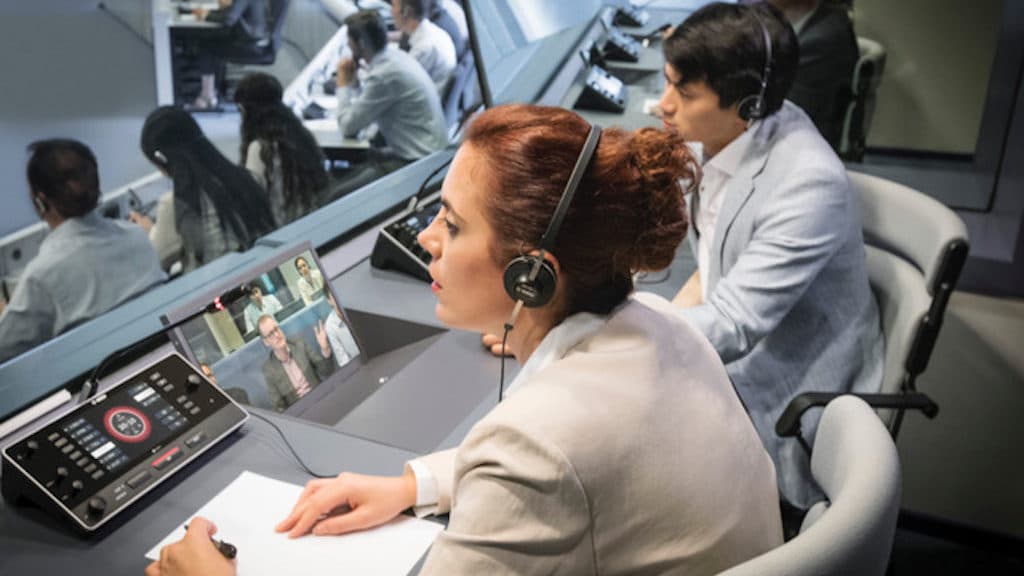
Simultaneous interpreting is a technique in which the interpreter renders the speaker's words into the target language in real time - typically with a lag of just two to three seconds - while the speaker continues talking without interruption. Delegates receive the interpretation through headsets connected wirelessly to the interpretation system. The interpreter works from a soundproofed booth, hearing the speaker through a headset and speaking the interpretation into a microphone.
The cognitive demands of simultaneous interpreting are extraordinary: the interpreter must listen, comprehend, memorise, reformulate and speak - simultaneously - for extended periods. This is why professional standards require a minimum of two interpreters per language channel, alternating every 25 to 30 minutes, even for half-day events.
Simultaneous vs consecutive interpreting: which do you need?
Simultaneous interpreting is appropriate when:
- The audience is large (typically more than 30 to 50 people) and interrupting the speaker would disrupt the event flow
- Multiple languages must be covered at the same time without doubling or tripling the event duration
- The event follows a strict programme schedule that cannot accommodate speaking pauses
- The content is dense, fast-paced or highly technical
Consecutive interpreting is more suitable when:
- The audience is small (under 30 people) and the setting is informal
- Only one or two language directions are needed
- The speaking intervals are naturally short and structured (e.g., diplomatic dinners, bilateral negotiations)
- No interpretation equipment is available or appropriate
TranslateBE
Simultaneous interpreting for your conference - quote in 1h
Expert simultaneous interpreters and ISO 2603-certified booths for conferences across Belgium, France, Luxembourg and beyond. 70+ languages available.
Equipment: booths, receivers and relay systems
Simultaneous interpreting requires three main categories of equipment. Interpretation booths must comply with ISO 2603 (for permanent installations) or ISO 4043 (for portable booths). They must be soundproofed, ventilated and positioned to give interpreters a direct sightline to the speaker and any presentation screen. Delegate receivers are wireless headsets that allow each audience member to select their preferred language channel. Interpreter consoles connect the interpreter to the audio feed, allow them to control volume and select the channel for relay interpreting.
For events requiring more than three language channels, a relay interpreting system is typically used: one pivot interpreter renders the source language into a widely spoken language (English or French), and relay interpreters then interpret from the pivot into their respective target languages. This system is standard at UN, EU and other large multilateral events.
Remote simultaneous interpreting (RSI) platforms such as Interprefy, KUDO and Zoom allow interpreters to work from any location and delegates to select language channels on their devices, making it an efficient option for hybrid or fully online events.
Typical costs and how to budget
Simultaneous interpreting costs are driven by four factors: the number of language channels, the event duration, the subject complexity and the location. A rough framework for planning:
- Interpreter fees: minimum two interpreters per language channel per day, with day rates varying by language combination and specialisation
- Equipment rental: booths, receivers and consoles for on-site events; platform licences for RSI
- Technical staff: one audio technician on-site throughout the event is strongly recommended
- Preparation time: interpreters bill for pre-event documentation review, which is non-negotiable for technical subjects
FAQ
Frequently asked questions
Can a single interpreter handle a full-day conference simultaneously?
No. Professional standards - and basic physiology - make this impossible. Simultaneous interpreting requires the cognitive engagement of listening, understanding, reformulating and speaking at the same time, sustained for hours. Beyond 25 to 30 minutes without a break, quality deteriorates sharply and errors increase. The minimum is two interpreters per language channel, alternating regularly throughout the event.
What is the difference between a permanent booth and a portable booth?
Permanent booths (ISO 2603) are fixed installations built into conference halls, offering optimal soundproofing, ventilation and sightlines. Portable booths (ISO 4043) are modular units that can be assembled and disassembled at any venue. Modern portable booths provide very good acoustic isolation and are suitable for professional conferences. The main trade-off is that portable booths require installation time before the event and removal after.
How much advance notice do you need to organise simultaneous interpreting for a Brussels conference?
For a standard two-language conference (e.g., FR-EN) of one or two days, two to four weeks is generally sufficient. For complex multi-language events, six to eight weeks is advisable to ensure interpreter availability and adequate preparation time. For very large congresses or events requiring rare language combinations, booking two to three months in advance is prudent.